For those who worry about the cultural, economic and political power of the global media companies, the dreamed-of revolution is at hand. The industry may right now be making a joyful noise unto the Lord, but it is we, not they, who are about to enter the promised land. (Moglen 2001)
Introduction
Technological changes have political implications. Changing the way we interact with things encourages a reconsideration of the rules and institutions that have governed previous interactions with them.
The current debate about copies of recorded music using the Internet is an excellent example of this, and by examining it one may better understand the relations between people and recorded music, and between listeners and the traditional publishers of music.
While undoubtedly a great deal may be usefully said and examined in other technological changes in music recordings, I will here focus primarily on filesharing, as it is something I have been somewhat involved in myself, and hence I have significantly more knowledge ‘from the inside.’
I will begin by discussing traditional definitions of ‘commodity,’ and then move on to a very brief overview of historical trends in copying and music recording. I will also touch upon the printing press in order to discuss the creation and rationale behind copyright laws, which form a major part the present filesharing debate. I will then go into greater depth into the current practises of people who share music on filesharing networks, and the response by the recording industry, before embarking on an analysis of the meaning and significance of some of these new practises and dialogues.
It should be noted that I’m speaking primarily of England and the United States of America, and the situation will be somewhat different in other parts of the world.
DuckDuckGo is a beautiful, fast and secure search engine, which actually cares about the users privacy and does not track you.
As too few people yet know about that amazing search engine I thought about a way how to promote it.
Here’s my solution for sysadmins and webmasters:
Include the following rewrite rule into your .htaccess on the Apache Server.
This week Cory Doctorow gave a great talk about this (*sigh*) boring old issue of Freedom and Human Rights in the age of the knowledge society at the ACM Siggraph Conference in Vancouver.
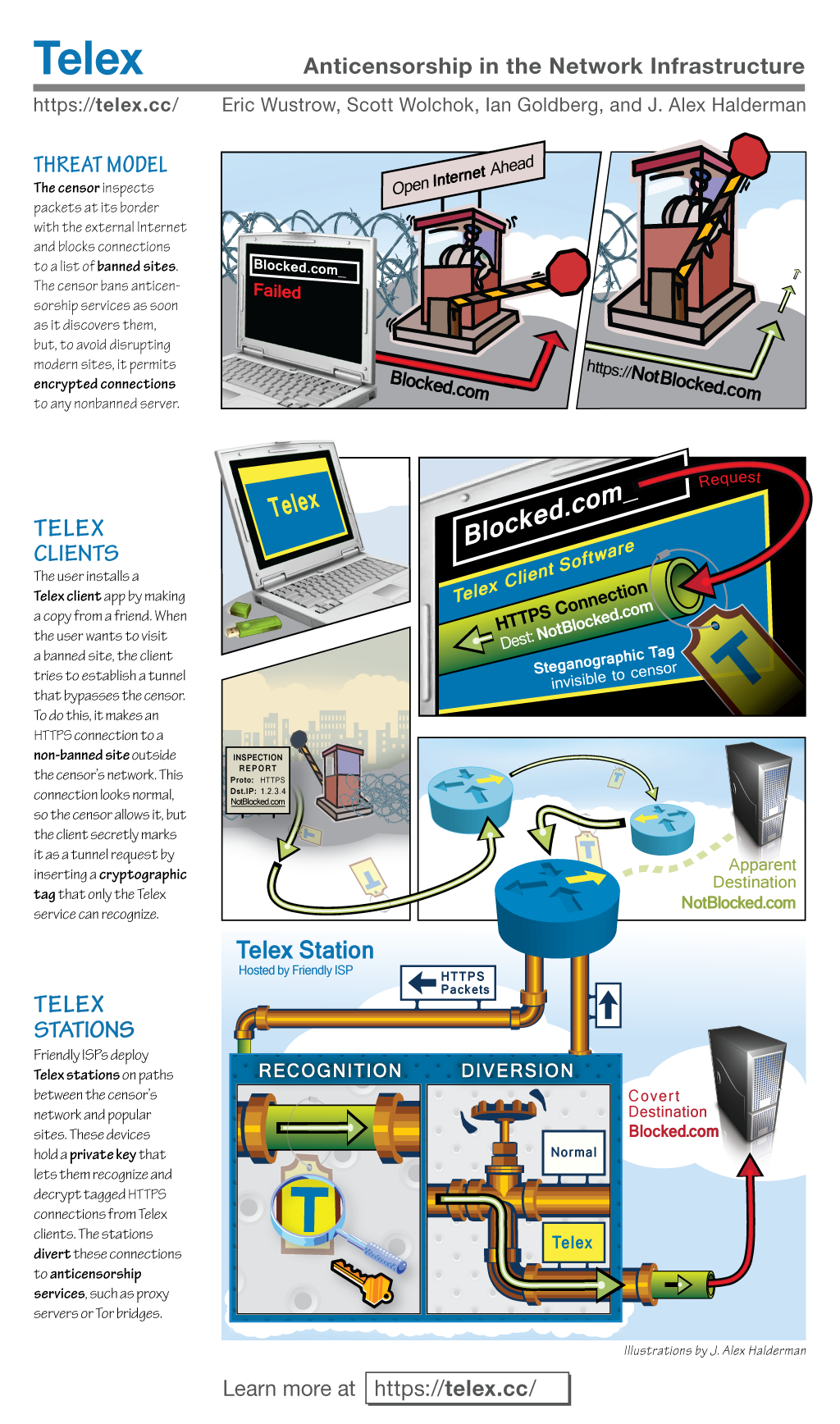
Anticensorship in the Network Infrastructure: Watch out for Telex.
Telex is a new approach to circumventing Internet censorship that is intended to help citizens of repressive governments freely access online services and information. The main idea behind Telex is to place anticensorship technology into the Internet’s core network infrastructure, through cooperation from large ISPs. Telex is markedly different from past anticensorship systems, making it easy to distribute and very difficult to detect and block.
What makes Telex different from previous approaches:
Telex operates in the network infrastructure — at any ISP between the censor’s network and non-blocked portions of the Internet — rather than at network end points. This approach, which we call “end-to-middle” proxying, can make the system robust against countermeasures (such as blocking) by the censor.
Telex focuses on avoiding detection by the censor. That is, it allows a user to circumvent a censor without alerting the censor to the act of circumvention. It complements services like Tor (which focus on hiding with whom the user is attempting to communicate instead of that that the user is attempting to have an anonymous conversation) rather than replacing them.
Telex employs a form of deep-packet inspection — a technology sometimes used to censor communication — and repurposes it to circumvent censorship.
Other systems require distributing secrets, such as encryption keys or IP addresses, to individual users. If the censor discovers these secrets, it can block the system. With Telex, there are no secrets that need to be communicated to users in advance, only the publicly available client software.
Telex can provide a state-level response to state-level censorship. We envision that friendly countries would create incentives for ISPs to deploy Telex.
Telepolis schreibt: “Nun gab der frühere EMI-Manager Douglas C. Merrill auf der CA World Expo in Sydney zu, dass eigene Studien seines ehemaligen Arbeitgebers ergaben, dass Personen, die über P2P-Dienste unlizenziert Musik herunterluden auch die besten Kunden von iTunes waren. Filesharing sieht er deshalb als “try-before-you-buy marketing”, für das die Musikindustrie nicht einmal zahlen müsse.” … – Wen wundert’s? Ach ja stimmt: Sony, EMI und die ganze Bande haben es immer noch nicht begriffen.
a key logger, and
a public/private key pair with empty passphrase, and
a launch daemon, and
a bash script using curl with a short connect timeout, and
a dynamic DNS service, and
double NAT forwarding through your two routers, and
local port forwarding to your laptop’s usual web server, and
a bash script at DocumentRoot with, occasionally,
a reverse port forwarding ssh command in it executed in the background with nohup, also to
the dynamic DNS address, and
another double NAT forwarding, and
appending the public key to your laptop’s authorized keys, and
running tail -F /var/log/apache2/access_log, and
…waiting